
The first day after water damage is about control, not perfection. You do not need to know every restoration term or decide every repair. You do need to protect people, stop additional water when that can be done safely, and preserve a clear record of what happened.
The source matters. A clean supply-line leak is managed differently from storm runoff or a sewage backup. Use the checklist below as a decision guide, and step back whenever electricity, a sagging ceiling, contaminated water, or unstable materials may be involved.
General guidance cannot clear an unsafe property. Stay away from energized water, sewage, moving floodwater, and sagging materials.
Minutes 0-15: protect people and stop the source
Keep children and pets away. If you can reach a fixture valve or the main water shutoff without stepping into water or touching wet electrical equipment, close it. If the source is a roof, outside runoff, sewage, or a line you cannot safely isolate, call for the appropriate emergency help.
- Do not enter standing water near outlets, appliances, extension cords, or an electrical panel.
- Stay out from beneath bulging or sagging ceilings.
- Treat drain or toilet backups as contaminated.
- Do not use a household vacuum on standing water.
Minutes 15-60: document the loss
Take wide photos of every affected room, then closer images of water levels, damaged finishes, appliances, and contents. Photograph the source when it is safe. Save failed hoses or plumbing parts if a contractor removes them, and write down when the problem was discovered and when the water was stopped.
- Capture adjoining rooms even if they look dry.
- Record model and serial numbers on affected appliances.
- Keep receipts for emergency purchases and temporary measures.
- Do not discard damaged belongings before photographing and inventorying them.
Hours 1-4: remove bulk water and trace the wet area
Standing water should be removed promptly, but extraction is not the same as complete drying. Water may be under carpet cushion, floating floors, cabinets, wall plates, or the room next door. A moisture assessment helps determine the true perimeter and whether controlled access is required.
- Move small dry valuables to a safe room.
- Place foil or plastic beneath furniture legs only if you can reach them safely.
- Avoid lifting heavy furniture or pulling up attached carpet without a plan.
- Do not point fans across sewage or dirty runoff.
Hours 4-24: establish a monitored drying plan
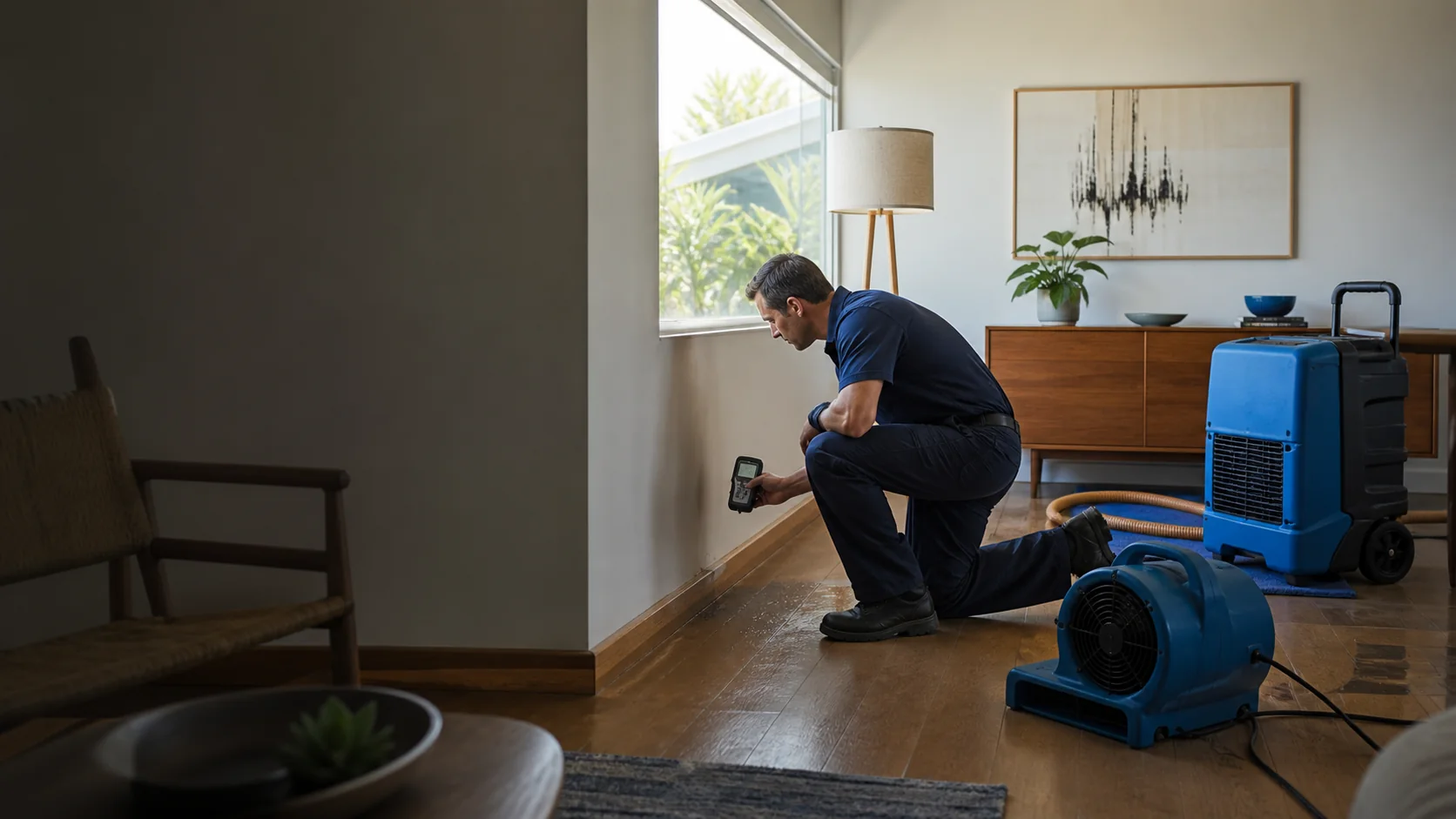
Drying should be based on materials and measurements. Air movement helps evaporation; dehumidification removes moisture from the air; extraction reduces liquid water first. Closing the room and adding heat without understanding the assembly can push moisture into other areas or damage finishes.
Ask what materials were measured, which areas are serving as dry comparisons, what equipment is being placed, and when conditions will be checked again. A plan that changes with the readings is more useful than a fixed promise about the number of days.
- Keep equipment running as directed unless a safety problem develops.
- Avoid moving machines or closing off airflow paths without asking.
- Notify the team if a new stain, odor, or wet area appears.
- Coordinate plumbing, roofing, or drain repairs before reconstruction.
Insurance and repair decisions can follow
Notify your carrier according to your policy and ask how it wants emergency work documented. Coverage decisions belong to the insurer, not the restoration contractor. A clear file can include photos, moisture records, invoices, a contents list, and the source professional’s findings.
Do not rush into cosmetic repair while the source or moisture condition remains uncertain. The responsible sequence is source control, mitigation, verified drying, cleaning, then repair.
How to apply this guide to a La Mesa property
The right response to first 24 hours after water damage begins with conditions at the building, not a generic checklist alone. Note whether the source is a pressurized supply, fixture or drain, water heater, appliance, roof, outside runoff, or an unknown pathway. Then record every room or level that may connect to it. A slab-on-grade Fletcher Hills home, a historic Rolando cottage, a Mt. Helix hillside property, and an apartment near Date Avenue may show the same stain for very different reasons. That building context determines which professional should stop the source and which finishes need closer moisture assessment.
When you request help, describe what changed and when: active flow, meter behavior, odor, warm flooring, material swelling, ceiling movement, recent rain, drain response, or a prior repair. Share whether electricity, sewage, tenants, customers, valuable contents, or limited access are involved. This allows the first conversation to focus on hazards and source control before equipment or repair decisions. For this topic, the most directly connected service paths are Emergency Help, Water Extraction, Water Restoration. Each addresses a different phase, so ask who is responsible for source repair, mitigation, monitoring, cleaning, contents, and reconstruction.
Document the property before cleanup changes the scene. Take wide photographs, close views, and a short video that establishes the relationship between the source and affected rooms. Keep a timeline, receipts, removed parts, source-trade findings, moisture records, and written scopes. If insurance may be involved, report the event according to the policy and ask what the carrier needs before damaged material is discarded. A contractor can explain observed conditions and recommended work; only the carrier can interpret coverage.
Finally, use the repair phase to prevent a repeat. Confirm that plumbing, roofing, drainage, ventilation, or appliance corrections were tested before finishes close the assembly. Ask what measurements support dry-out, what materials were retained or removed and why, and how continuous flooring, cabinets, plaster, or historic finishes affect the repair boundary. If water is still moving, the ceiling is changing, electricity may be involved, or sewage is present, call now. For a controlled leak, use the same sequence—safety, source, documentation, extraction, and verified drying—to keep a manageable loss from becoming a larger repair.
- Protect people before protecting finishes.
- Stop or isolate the source when that can be done safely.
- Map the water beyond the most visible mark.
- Separate emergency mitigation from permanent repair.
- Keep one organized record from discovery through closeout.
The bottom line
If water is still moving, the ceiling is changing, electricity may be involved, or sewage is present, call now. For a controlled leak, use the same sequence—safety, source, documentation, extraction, and verified drying—to keep a manageable loss from becoming a larger repair.